The creative industry is experiencing a major structural shift driven by automation and generative intelligence. The traditional path from concept art to finished 3D assets is being redesigned by a new category of tools known as image to 3D AI, which allows creators to transform 2D visuals directly into 3D models. Alongside this shift, image to 3D model AI is becoming a core part of modern production pipelines across gaming, film, e-commerce, and digital design.
What was once a slow, multi-stage production process is now evolving into a faster, more flexible, and highly iterative workflow.
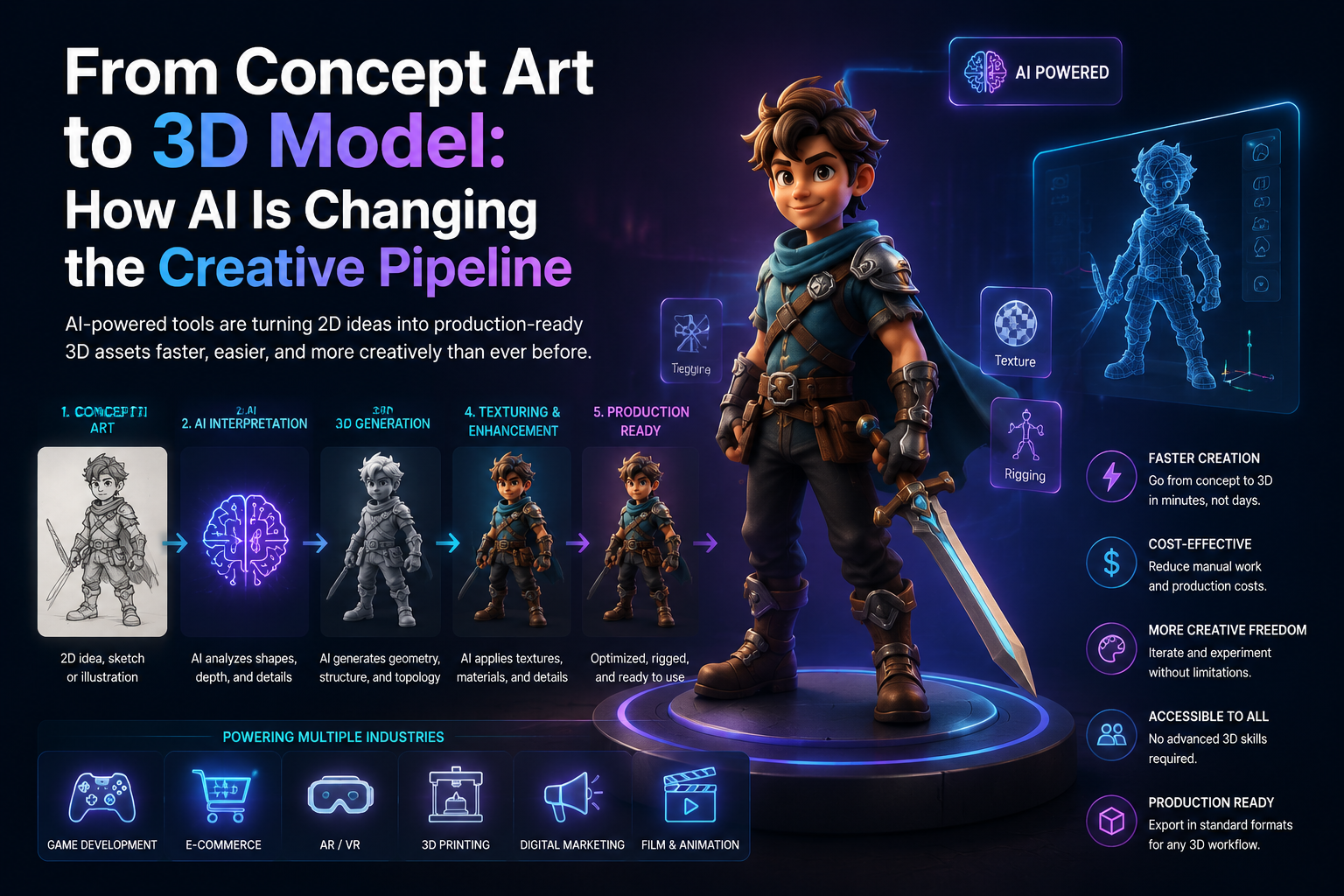
alt: From Concept Art to 3D Model: How AI Is Changing the Creative Pipeline
The Traditional Creative Pipeline and Its Limitations
In the conventional workflow, turning concept art into a 3D model requires multiple specialized roles and steps:
- Concept artists create initial sketches or illustrations
- 3D modelers manually reconstruct geometry in modeling software
- Texture artists apply materials and surface details
- Rigging artists prepare models for animation
- Technical artists optimize assets for performance and export
Each stage depends on the previous one, creating a linear pipeline that is slow and difficult to iterate. Even small changes in concept art often require significant rework in downstream stages.
This structure has long limited the speed and scalability of 3D production.
How Image to 3D AI Changes the Starting Point
With image to 3D AI, concept art is no longer just a reference image—it becomes the direct input for 3D generation.
Instead of manually rebuilding shapes, AI systems analyze the image to extract:
- Object boundaries and silhouettes
- Depth and perspective cues
- Lighting and shadow information
- Semantic understanding of objects and materials
From this analysis, a base 3D structure is generated automatically. This allows creators to move from idea to 3D draft in a fraction of the traditional time.
In parallel, image to 3D model AI extends this capability by improving geometry reconstruction, texture inference, and model usability across different workflows.
A New Creative Pipeline Powered by AI
The traditional linear pipeline is being replaced by a more dynamic and iterative structure.
1. Concept Stage
Artists provide sketches, mood boards, or reference images.
2. AI Interpretation Stage
Image to 3D AI analyzes visual input and builds a spatial understanding of the concept.
3. 3D Generation Stage
A base mesh is created automatically, forming the structural foundation of the model.
4. Refinement Stage
Instead of rebuilding from scratch, creators adjust outputs using iterative AI guidance or manual tweaks.
5. Production Output Stage
The final model is exported for use in games, animation, AR/VR, or 3D printing.
This workflow is no longer strictly linear. It allows constant back-and-forth between concept and model, making iteration significantly faster.
Why This Transformation Matters
The adoption of image to 3D AI is not just a productivity upgrade—it changes how creative teams function.
Faster Idea Validation
Concepts can be tested in 3D almost immediately after being drawn.
Reduced Technical Barriers
Non-technical creators can participate in 3D production without deep modeling expertise.
More Iterative Design Process
Creators can explore multiple variations of a concept without restarting the entire pipeline.
Lower Production Costs
Smaller teams can produce large volumes of 3D assets without heavy outsourcing.
Industry Applications of Image to 3D Model AI
The impact of image to 3D model AI is already visible across multiple industries.
alt: 3D Printing result generated by Image to 3D AI
Game Development
Developers use AI-generated models for rapid prototyping of characters, props, and environments before final production.
Film and Animation
Directors and artists can quickly turn storyboards into 3D pre-visualization scenes.
E-Commerce
Product images can be converted into interactive 3D models, improving online shopping experiences.
AR and VR
Immersive environments can be populated quickly with AI-generated assets.
Industrial and Product Design
Early-stage concepts can be tested in 3D before manufacturing decisions are made.
The Evolving Role of Human Creators
Despite automation, image to 3D AI does not remove the need for human creativity. Instead, it shifts the focus of creative work.
Artists and designers now spend more time on:
- Concept direction
- Visual storytelling
- Style refinement
- Iterative evaluation of AI-generated results
Rather than replacing creators, image to 3D model AI enhances their ability to explore and execute ideas more efficiently.
Current Challenges in AI-Driven 3D Creation
While powerful, image to 3D AI still faces several technical limitations:
- Ambiguity in single-image inputs can lead to incomplete geometry
- Complex topology may require manual cleanup
- Fine artistic control is still stronger in traditional tools
- Highly stylized or abstract designs may not translate perfectly
These challenges suggest that hybrid workflows combining AI and manual editing will remain important.
The Future of the Creative Pipeline
The future of image to 3D model AI points toward even deeper integration into creative tools and workflows.
We can expect:
- Real-time conversion of sketches into editable 3D scenes
- More accurate depth and structure prediction models
- Seamless integration with game engines and design software
- AI systems that understand artistic intent at a higher level
- Fully automated asset generation pipelines for entire projects
As these systems evolve, the boundary between concept creation and 3D production will continue to blur.
Conclusion
The shift brought by image to 3D AI represents a fundamental change in how digital assets are created. By transforming concept art directly into 3D models, it removes long-standing bottlenecks in the creative pipeline and enables faster, more flexible production workflows. At the same time, image to 3D model AI is redefining the role of creators, making 3D development more accessible while expanding creative possibilities.
As the technology continues to mature, image to 3D AI will not just accelerate production—it will reshape the entire creative pipeline from concept to final output.