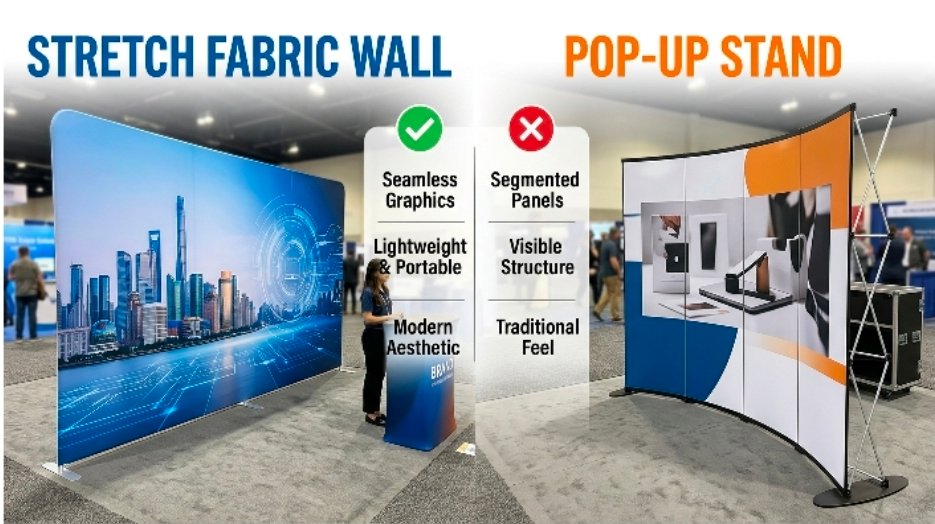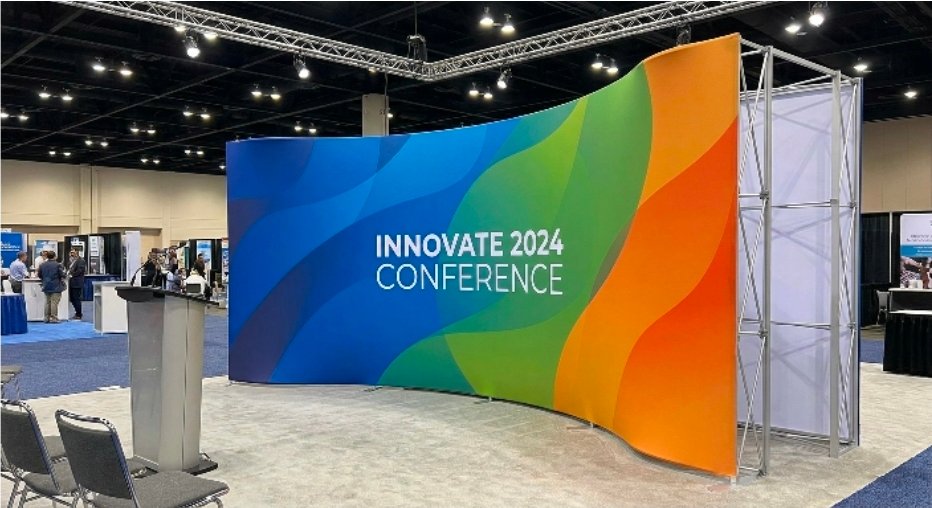
The shift did not happen suddenly. There was no single innovation moment, no dramatic replacement announcement. Instead, fabric-based display systems began appearing quietly alongside traditional rigid panels – and then slowly taking their place.
At first, they were treated as alternatives. Then as options. Eventually, for many exhibitors, they became defaults.
This transition was not driven by trends or aesthetics alone. It emerged from repeated use, changing exhibition logistics, and a growing awareness of how display systems behave once they leave ideal conditions.
Rigid panels still exist. But fewer exhibitors rely on them year after year. Understanding why reveals far more about real exhibition behaviour than about materials themselves.
How Rigid Panel Systems Originally Earned Their Place
Rigid panel displays dominated exhibitions for a long time for good reasons.
They felt solid. They looked professional. They created sharp edges and defined boundaries. In static environments, they performed exactly as expected.
For many years, exhibitions themselves supported this approach. Venues were predictable. Install teams were consistent. Event schedules were lighter. Displays were used fewer times per year. In that context, rigid systems made sense.
They rewarded precision and produced clean results — provided conditions remained controlled.
What Changed Around Exhibitions, Not Displays
The decline of rigid panels did not begin with material failure. It began with environmental change.
Exhibitions Became More Frequent
Brands began attending more shows per year. Smaller regional events appeared alongside large trade fairs. Pop-ups, roadshows, and temporary activations became normal.
Displays were no longer installed once and stored for months. They were assembled, dismantled, transported, and reused constantly. Systems designed for occasional deployment were suddenly operating under repeated stress.
Logistics Became Less Forgiving
Exhibitions increasingly required faster turnaround times. Build windows shortened. Storage space became limited. Teams travelled with their own equipment rather than relying on contractors.
Under these conditions, rigid panels revealed their limits.
Where Rigid Panels Begin to Struggle Over Time
Rigid systems rarely fail immediately. They struggle gradually.
Transport Creates Accumulated Damage
Rigid panels demand protection. Edges chip. Corners bruise. Surfaces mark. Each journey introduces small imperfections. Individually minor, collectively visible.
Exhibitors often discover that panels still function — but no longer look consistent. That inconsistency becomes difficult to ignore.
Weight Changes Handling Behaviour
Heavier panels are not lifted carefully every time. They are leant, slid, and stacked in ways never intended.
This behaviour is not negligence. It is inevitable.
Over time, systems that require perfect handling begin to deteriorate faster than those designed to tolerate human shortcuts.
Replacement Becomes Fragmented
Once a single panel is damaged, replacement becomes complicated.
Colours may not match perfectly. Finishes age differently. Systems lose uniformity.
At that point, rigid panels stop feeling like systems and start feeling like compromises.
Why Fabric-Based Systems Behave Differently
Stretch Fabric-based display systems approach exhibitions from a different direction.
They do not resist movement. They absorb it.
Rather than relying on surface rigidity, they rely on tension and flexibility — allowing materials to recover rather than fracture. This difference becomes increasingly important as usage increases.
Fabric Accepts Repetition
Printed fabric folds without permanent damage. Creases relax. Surfaces return to form once tensioned. Where rigid panels accumulate scars, fabric systems accumulate memory — then release it.
This behaviour alone explains much of their longevity.
Frames Are Designed for Reassembly
Fabric systems are built around repeated breakdown.
Connections are made to tolerate wear rather than eliminate it. Slight looseness is intentional. Alignment is guided rather than forced. The goal is not precise perfection but reliable assembly under imperfect conditions.
How Setup Behaviour Influences System Survival
Exhibitors rarely assemble displays under calm conditions. Time pressure is normal. Distractions are constant. Floors are uneven. Lighting is inconsistent.
Rigid panels demand accuracy. Fabric systems accept approximation. That difference shapes long-term satisfaction.
Adjustment Versus Correction
Rigid panels often require correction. Panels must be realigned. Edges must meet perfectly.
Fabric systems allow adjustment instead. Tension compensates for small inconsistencies.
This reduces frustration — and reduces physical stress on components.
Psychological Ease Matters
Systems that feel cooperative reduce setup fatigue.
Teams approach them with confidence rather than caution.
Over time, this psychological comfort becomes as valuable as physical durability.
Storage and Space Efficiency Over Time
Between events, displays live in storage.
Here, fabric systems quietly outperform rigid alternatives. Fabric graphics compress. Frames pack compactly. Cases remain manageable. Rigid panels demand flat storage and careful stacking. As exhibition schedules become busier, storage space becomes more valuable for businesses that regularly attend trade shows and promotional events. Systems that store efficiently survive. Others become burdens. This is one of the least discussed yet most influential reasons for the transition.
Cost Behaviour Across Multiple Events
Initial cost comparisons often favour rigid systems. Long-term cost behaviour tells a different story.
| Cost Factor Over Time | Rigid Panels | Fabric-Based Systems |
| Transport cost | Higher | Lower |
| Storage demand | Significant | Minimal |
| Damage replacement | Frequent | Rare |
| Graphic updates | Expensive | Simple |
| Visual consistency | Degrades | Maintains |
Fabric systems often cost less not because they are cheaper — but because they require less correction.
Visual Performance Under Exhibition Lighting
Exhibition lighting is unpredictable. Hot spots. Mixed temperatures. Reflections. Shadows. Rigid surfaces reflect light sharply, causing glare that can make graphics appear uneven and photographs look inconsistent. Fabric, by contrast, diffuses light naturally, allowing colours to appear calmer and images to remain clear from multiple angles. This is especially valuable when showcasing printed marketing materials such as flyers, posters, and stickers, where colour accuracy and visual clarity play a key role in attracting visitors. Whether your exhibition stand also includes branded literature or a professionally designed business card for networking, consistent lighting helps every printed element look polished and reinforces a strong, professional brand presence.
When Rigid Panels Still Make Sense
This transition does not mean rigid panels are obsolete.
They still perform well when:
- installations are permanent or semi-permanent
- displays are not transported frequently
- professional installers handle setup
- environments remain consistent
Rigid panels excel in controlled spaces. Problems arise when they are used outside those conditions.
Why the Shift Continues — Quietly
Fabric systems do not replace rigid panels through marketing. They replace them through experience.
Exhibitors switch after noticing:
- fewer repairs
- easier transport
- faster builds
- calmer setups
- consistent visuals
The change rarely feels dramatic. It feels sensible.
And once made, it is rarely reversed.
What the Future Suggests
As exhibitions continue to diversify, flexibility becomes more valuable than rigidity.
Systems must adapt to:
- varying booth sizes
- tighter schedules
- mixed teams
- rapid graphic updates
Fabric-based display systems align naturally with this direction. They are not perfect. But they are tolerant. And tolerance is what long-term exhibition use demands most.
Final Perspective
Fabric-based display systems continue to replace rigid panels not because they look modern — but because they behave realistically.
They acknowledge repetition. They accept handling. They recover from movement. They adapt to inconsistency.
Rigid panels aim for perfection.
Fabric systems aim for endurance. In exhibition environments defined by time pressure and repeated use, endurance proves more valuable.
That is why many brands now treat fabric displays as infrastructure rather than equipment — and why suppliers such as I YOU PRINT increasingly support clients with systems designed for longevity rather than one-time appearance.