

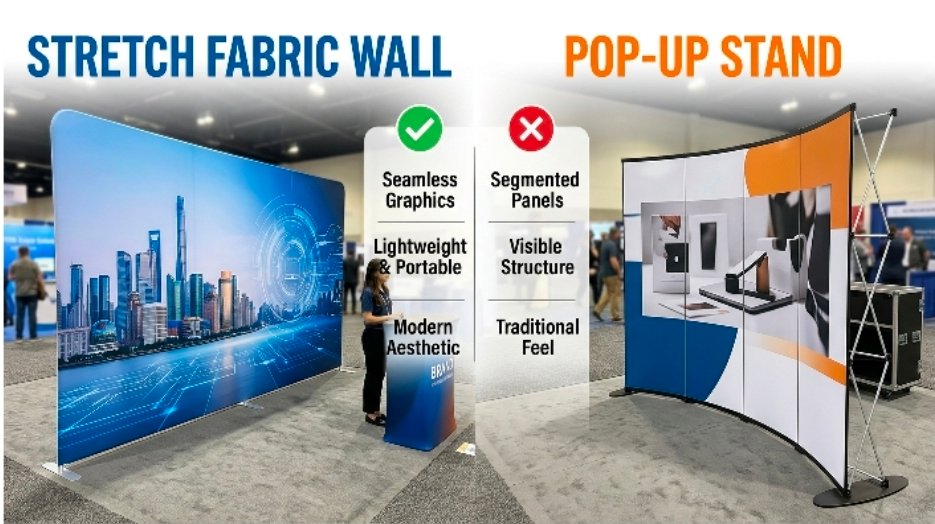
Walk the aisles at any UK trade show this year and the shift is visible before you’ve reached the second hall.
Ten years ago, the majority of mid-size stands were pop-ups: curved magnetic frames with printed panels clipped over them, with those faint vertical seams where the panels met. Today, more of those same stands are built around a stretch fabric wall for exhibition stand use — one seamless printed skin, no panel joins, no glare under the hall lighting. The pop-up hasn’t disappeared. It’s simply stopped being the automatic choice, and the businesses still buying them are increasingly doing so for specific, deliberate reasons rather than out of habit.
That distinction matters if you’re specifying a stand this year. Both formats work. Both have a legitimate place. What’s changed is which one suits which buyer and the honest answer isn’t the one most display suppliers give, because most display suppliers only sell one of them properly.
What Each System Actually Is, Beneath the Marketing
A pop-up stand is a concertina frame, usually magnetic or scissor-action, that expands to shape. Printed graphic panels — typically laminated PVC or a synthetic display board — attach across the front, either magnetically or by clipping into channels. The finish depends heavily on the laminate. Matt laminates control glare reasonably well; gloss ones look punchy in a photograph and considerably less so under the flat, bright LED wash of a modern exhibition hall.
A tension fabric wall works differently. An aluminium extrusion frame is assembled, and a single printed polyester skin is pulled taut over it. The graphic is dye-sublimated, meaning the ink is driven into the fibre under heat rather than sitting on the surface as a coating, and a silicone strip stitched around the fabric edge locks into a channel in the frame. Tension does the finishing. There are no panels, so there are no seams, and because the surface is fabric rather than laminated board, it doesn’t reflect light back at anyone standing in front of it.
That last point is worth sitting with, because it’s the reason so many marketing teams switched without ever consciously deciding to. Fabric photographs cleanly. Laminate doesn’t always.
Build Time and Handling: The Difference Nobody Costs Properly
Ask an exhibitor which format is faster to build, and most will say the pop-up, because that’s the reputation it’s carried since the nineties. In practice it’s closer than expected, and it depends entirely on how many shows you’re doing.
A pop-up frame does expand quickly. The time goes into the panels — aligning them, keeping the magnetic strips seated, and dealing with the fact that laminated panels scuff, fingerprint and pick up handling marks that show under bright lighting. Panels also need to be rolled, not folded, which means a rigid tube or case and a genuine constraint on how kit travels.
A stretch fabric exhibition display takes slightly longer to assemble the frame and considerably less time to finish. The fabric goes on once, tensions itself, and there’s nothing to align. It folds rather than rolls, which is why a 3m fabric exhibition wall fits in a bag one person can carry, while the pop-up equivalent usually needs a wheeled case.
For a business doing two events a year, this barely registers. For one doing eight, with staff building the stand themselves at 7am before a 9am opening, it changes the working day. And if you’re paying a contractor by the hour at a venue like ExCeL or the NEC, it changes the invoice.
| Consideration | Pop-Up Stand | Stretch Fabric Wall |
| Finish | Visible panel seams, laminate surface | Seamless single skin, matt fabric |
| Glare under hall lighting | Noticeable, especially gloss laminate | Minimal — fabric diffuses light |
| Transport | Rolled panels, rigid case required | Folded fabric, soft carry bag |
| Typical build | Fast frame, slower panel alignment | Slower frame, near-instant graphic |
| Graphic replacement | Reprint full panel set | Reprint fabric only, reuse frame |
| Handling marks | Scuffs and fingerprints show | Washable, marks less visible |
| Best suited to | Occasional use, fixed-size booths | Repeated use across a season |
Where the Money Actually Goes Across Three Years
First-invoice comparisons mislead people here, and it’s the single most common buying mistake we see.
On day one, a pop-up and an equivalent-width exhibition backdrop wall often land in a similar bracket. The divergence starts at the first rebrand, the first price change, or the first time a panel gets damaged in transit. With a pop-up, a damaged or outdated graphic usually means reprinting the whole panel set — the hardware is fine, but the printed element is not economically separable in the way buyers assume. With a fabric wall, the frame is the durable asset and the fabric is the consumable. Reprint the skin, keep the frame, and the cost sits well below a full replacement.
That’s the structural difference. One system treats the graphic as part of the product; the other treats it as a replaceable component.
It also affects how you plan a year. Exhibitors running regional shows alongside a flagship event often want slightly different messaging at each – sector-specific wording in Birmingham, something broader in London. On a fabric system that’s a second skin on the same frame. On a pop-up it’s a second set of panels and a second case to store them in.
Storage deserves a mention too, because it’s a real cost that appears on nobody’s quote. Rolled pop-up panels need protecting from creasing and pressure damage, which means the case takes up floor space in a stockroom for the eleven months a year it isn’t at a show. Folded fabric goes on a shelf.
Common Mistakes UK Exhibitors Make When Choosing
- Comparing purchase price alone, without factoring in reprint cost across two or three seasons
- Choosing a gloss laminate pop-up for a hall with heavy overhead lighting, then wondering why the stand photographs badly
- Buying a fixed-width system before checking the booth sizes on next year’s show calendar
- Assuming all fabric walls print to the same standard, when fabric weight and dye-sublimation quality vary considerably between suppliers
- Ordering the backdrop from one supplier and the banners, posters and flyers from another, then discovering the brand colours don’t match on the stand
When a Pop-Up Stand Is Still the Better Buy
This is where most comparison articles quietly stop being useful, because they’re written by suppliers who only sell one format.
Pop-ups remain a sensible purchase in a few genuine situations. If you exhibit once or twice a year at the same venue with the same booth size, the reusability advantage of a tension fabric wall never gets a chance to pay for itself. If your graphic is heavily photographic and you specifically want the sharpness a laminated panel gives at very close viewing distance, a good pop-up holds a slight edge. And if you already own a serviceable pop-up frame, replacing working hardware to chase a marginally better finish is rarely the best use of a marketing budget a reprint of the existing panels will usually serve you better.
Conversely, if your calendar involves multiple venues, varying booth widths, frequent messaging changes, or staff building the stand themselves, a stretch fabric wall for exhibition stand use is the more economical system over any realistic time horizon.
There’s a third option worth knowing about, which isn’t really a competitor to either. An SEG fabric display uses the same silicone edge principle as a fabric wall but is specified for fixed installation in reception areas, showrooms, and retail walls. If your branding lives permanently in one building rather than travelling, that’s the product to look at rather than a portable exhibition display wall.
| Your Situation | Recommended Format | Why |
| One or two shows a year, same booth size | Pop-up stand | The reuse advantage never materialises |
| Six or more shows across varied venues | Stretch fabric wall | Frame reused, fabric reprinted cheaply |
| Frequent rebrands or messaging changes | Stretch fabric wall | Skin replaced without new hardware |
| Stand built by internal staff, tight build windows | Stretch fabric wall | Lighter, folds flat, no panel alignment |
| Permanent office or retail branding | SEG fabric display | Built for fixed installation |
| Existing pop-up frame in good condition | Reprint panels | Replacing working hardware rarely pays |
Getting the Artwork Right, Whichever You Choose
The format decision is only half of it. Print quality on either system comes down to what you supply and how it’s produced.
Fabric wants generous bleed and a design that tolerates slight tensioning movement at the edges, so critical text and logos should sit well inside the safe area rather than flirting with the frame line. Very fine detail and hairline rules behave differently on woven polyester than on laminated board not worse, but softer and worth accounting for at the design stage rather than discovering at proof.
Solid blocks of a single brand colour are the other thing to think about. They look superb when printed well, and they’re the first place any folding crease or panel misalignment becomes visible. A design with texture, gradient or photographic content hides day-to-day wear far more forgivingly across a long season.
Most stands don’t live on the backdrop alone, either. The wall sets the frame, but the working parts of a booth are the banner marking the entrance, posters carrying supporting messages, flyers for people passing through, and booklets on the counter for the ones who stop and want detail. When those come from different suppliers with different colour profiles, the mismatch is subtle but genuinely noticeable usually at the exact moment you want the stand to look deliberate rather than assembled.
Where I YOU PRINT Comes In
We print stretch fabric Display in Croydon using dye-sublimation onto display-grade polyester, with a turnaround typically around four working days and free UK delivery. Replacement fabric can be ordered on its own whenever your messaging changes, without buying new hardware — which is where the cost advantage over a pop-up shows up in year two rather than year one.
Because the same studio also produces banners, posters, flyers, booklets and SEG fabric display systems, a full stand set can be printed with consistent colour throughout rather than pieced together from three suppliers who’ve each interpreted your brand colours slightly differently.
If you’re weighing a stretch fabric wall for exhibition stand use against a pop-up and aren’t certain which suits your calendar, tell I You Print how many shows you’re doing and what booth sizes you’ve been given. We’ll be straightforward about which one we’d actually recommend — including the times when the pop-up is the better choice.


One thought on “Stretch Fabric Wall vs Pop-Up Stand: Which Exhibition Display Is Best for Your Business?”