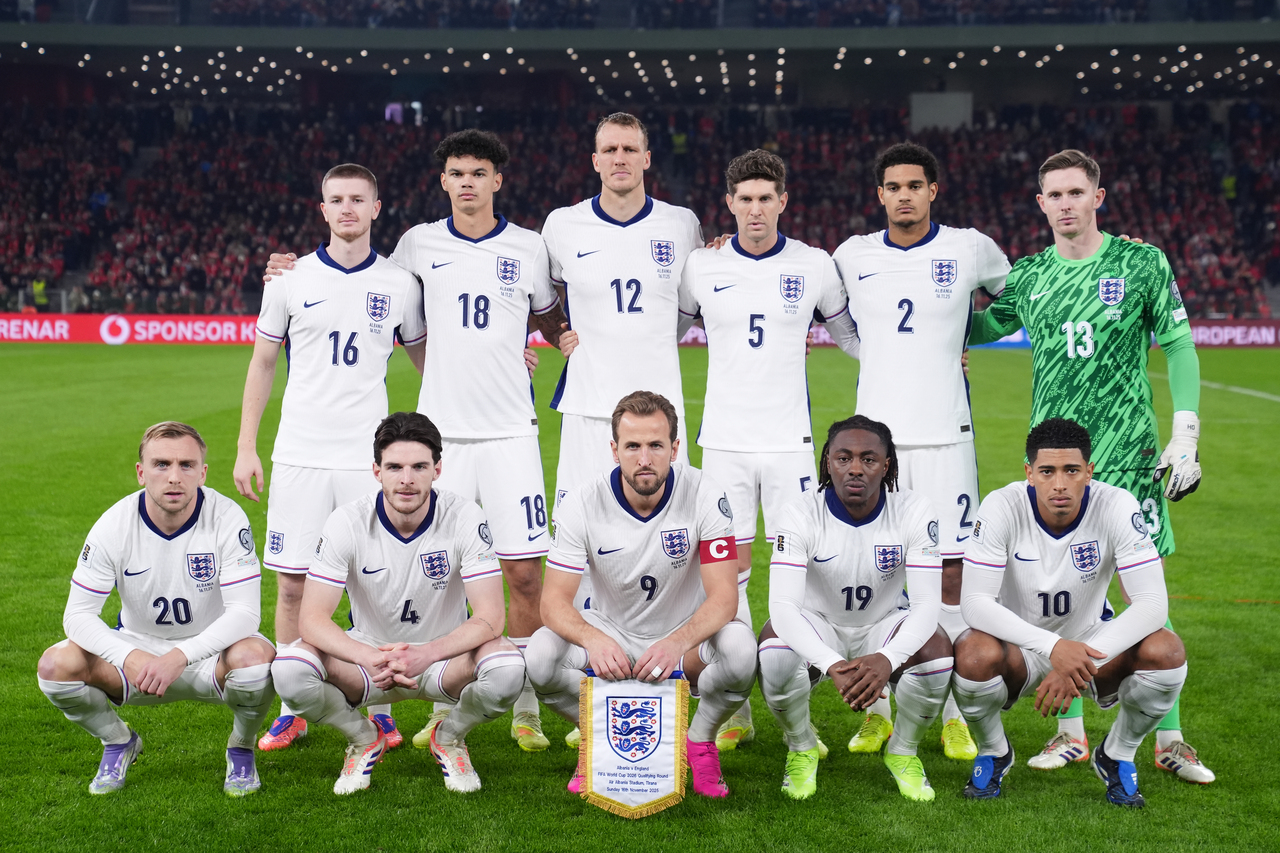
England arrive at the FIFA World Cup 2026 as one of the tournament’s most credible title contenders. The appointment of Thomas Tuchel as head coach marked a decisive shift in direction, not a rupture with the past but a refinement of it. After years of near-misses under Gareth Southgate, the Football Association turned to a manager with proven elite pedigree and a reputation for tactical clarity, demanding standards, and knockout-stage expertise.
The objective is explicit: add a second star to the famous white shirt, ending a drought that has lasted since 1966. What separates this England side from previous iterations is not just talent, but timing. This is no longer a team built around promise and potential alone; it is a squad entering its competitive prime, shaped by elite club environments and accustomed to pressure at the highest level: an evolution closely followed not only by analysts and scouts, but also across sports betting sites UK, where market confidence increasingly reflects England’s growing competitive maturity.
World Cup 2026 odds: respect from bookmakers, expectations from everyone else
The global betting markets reflect that maturity. England are widely priced as the second favourite to lift the trophy in North America, trailing only Spain. Current outright odds broadly read as follows:
-
Spain: 9/2
-
England: 13/2, implying roughly a 13.33% chance of winning the tournament
-
France: between 7/1 and 15/2
-
Brazil: between 8/1 and 17/2
What matters more than the raw numbers is their consistency. England’s price has remained stable across markets, even accounting for the expanded 48-team format, which introduces an additional knockout round and, statistically, more room for volatility. Bookmakers are effectively pricing England as a low-risk contender: not immune to shocks, but far less vulnerable than in previous cycles.
That confidence is rooted in recent tournament behaviour. England have made a habit of reaching the latter stages of major competitions, building a reputation for reliability rather than romance. In a format that rewards squad depth and mental endurance, that trait carries significant value.
Tuchel’s England: control without conservatism
From a tactical perspective, Tuchel has settled quickly on a 4-2-3-1 structure. During qualification, England won all eight matches, conceding zero goals, while maintaining a high share of possession and territorial dominance.
Unlike some of Tuchel’s club sides, this England team is not defined by relentless pressing for its own sake. Instead, it operates with controlled intensity. The defensive block is compact, pressing triggers are selective, and transitions are managed with discipline. England are happy to circulate the ball patiently, confident that quality in advanced areas will eventually create separation.
The established core
Certain players have become non-negotiable within this framework.
In goal, Jordan Pickford remains the clear first choice. While debate around his club form resurfaces periodically, his international performances continue to justify Tuchel’s trust, particularly in high-pressure moments.
At centre-back, the preferred pairing of John Stones and Marc Guehi offers a blend of composure, positional intelligence, and progressive passing. Ezri Konsa provides depth of near-equal quality, a luxury England have not always enjoyed.
On the right, the balance between creativity and defensive reliability is embodied by the competition between Trent Alexander-Arnold and Reece James. Tuchel appears inclined toward Alexander-Arnold when control and chance creation are priorities, accepting a degree of defensive risk in exchange for structural advantage.
In midfield, Declan Rice is the tactical anchor. More than a destroyer, he functions as the team’s primary organiser, setting tempo and positioning. Alongside him, Elliot Anderson has emerged as a high-energy complement, adding ball-winning intensity and vertical running.
Further forward, Jude Bellingham operates as the central creative force, drifting intelligently between lines, while Bukayo Saka offers consistency, pace, and decision-making from the right flank. At the tip of the attack stands Harry Kane, captain, record scorer, and tactical reference point.
The left-side dilemma
If there is a genuine selection headache, it lies on the left. Defensively, Nico O’Reilly has impressed with maturity beyond his years, yet faces competition from Myles Lewis-Skelly and a fully fit Luke Shaw, whose tournament experience still carries weight.
Higher up the pitch, the debate is even sharper. Marcus Rashford, revitalised after a productive loan spell at Barcelona, offers penetration and finishing, while Anthony Gordon provides relentless pace and defensive work rate. Hovering in the background is Cole Palmer, viewed by many analysts as a potential game-changer capable of reshaping matches from either flank or even centrally.
Tuchel’s eventual choice will likely be opponent-dependent rather than fixed, signalling a more pragmatic, matchup-based approach than England have historically employed.
Group stage and projected knockout path
England have been drawn into Group L alongside Croatia, Ghana, and Panama. They are heavy favourites to top the group, priced around 2/7 to finish first.
The implications of that position are significant. Winning the group would likely produce a route featuring a third-placed qualifier in the round of 32, followed by a possible round-of-16 meeting with Mexico, a quarter-final against Brazil, a semi-final versus Argentina, and potentially a final against Spain at MetLife Stadium on 19 July.
Finishing second, by contrast, could trigger an early collision with Spain as soon as the round of 16, dramatically altering the tournament outlook. In a competition where margins are slim, group-stage management becomes almost as important as knockout performance.
Betting perspective and squad depth
From a betting standpoint, England’s appeal lies in depth and adaptability. A 48-team tournament places enormous strain on squads, and England’s bench options compare favourably with any rival. Players such as Adam Wharton are increasingly viewed as ideal complements to Rice, offering composure in possession that England have historically lacked.
The one lingering concern remains Kane’s understudy. While Ollie Watkins and Dominic Solanke provide alternatives, neither replicates Kane’s unique blend of playmaking and finishing. Any extended absence of the captain would force structural adjustments rather than like-for-like replacement.
England in 2026 are no longer defined by youthful promise or narrative hype. They are a finished product, guided by a manager comfortable with elite expectations and supported by a generation of players hardened at the top level of club football.
The odds reflect that reality, but they also underline the challenge ahead. Winning a World Cup still requires navigating pressure, randomness, and moments of chaos. England have addressed most of their historical weaknesses. Whether that proves enough to overcome history itself will define not only this tournament, but an entire era of English football.