
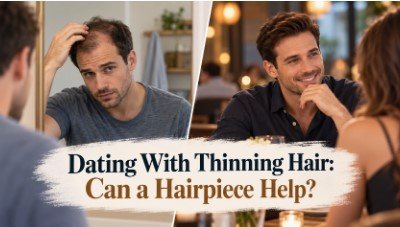
Dating with Thinning Hair: How Wearing a Hairpiece Actually Took Away My Second-Date Anxiety
First dates weren’t actually the problem.
Second dates were.
On a first date, everything was new. I could choose the restaurant, check my hair before leaving, find the angle I liked in the mirror, and tell myself I’d probably never see this person again anyway.
Then a date would go well.
Suddenly, I had a completely different set of questions.
What happens when she sees me in brighter lighting? What if we’re outside and it’s windy? What if she touches my hair? If this turns into an actual relationship, how long can I keep worrying about whether my thinning crown is visible?
The strange thing was that my hair wasn’t ruining my dates.
Thinking about my hair was.
Eventually, wearing a hairpiece changed that—not because it magically made me confident, but because I stopped spending so much of the date checking my own appearance in my head.
I Had Developed a List of “Safe” Dates
I didn’t call them safe dates at the time.
Looking back, that’s exactly what they were.
Indoor restaurants were good.
Dim lighting was even better.
Sitting across from someone was preferable to sitting beside them because I knew which angles showed the thinning area most clearly.
Outdoor afternoon dates?
Less appealing.
Bright sunlight had become something I noticed constantly. So had wind.
None of this was written down, of course. It was just a collection of tiny decisions I’d started making automatically.
That’s what surprised me most about thinning hair.
The amount of mental space it occupied was much larger than the actual patch of scalp.
The Mirror Check Never Really Ended
Before leaving home, I’d style my hair carefully.
Then I’d check it again.
And again.
The front usually looked fine. The crown was harder because I couldn’t see it naturally without another mirror or my phone camera.
I’d take a photo.
Adjust the hair.
Take another photo.
Sometimes I’d use styling products or fibers to make the area appear fuller.
The result might actually look perfectly acceptable.
But by then I’d spent so much time examining the thinning area that it felt enormous to me.
That mindset followed me out the door.
Why Second Dates Felt Different
A first date is a snapshot.
A relationship is repeated exposure.
That’s why the second date triggered more anxiety for me than the first.
If someone liked me enough to meet again, there was now the possibility of a third date. Then a fourth.
Eventually, there would be mornings, swimming, traveling, bad weather, unexpected plans, and all the other situations you can’t carefully stage.
I started thinking ahead.
Not because anyone had criticized my hair.
They hadn’t.
I was the one creating the problem in advance.
The question in my head became less about whether someone could see that my hair was thinning and more about how long I wanted to keep thinking about it.
Shaving Was the Obvious Advice
Like many men losing their hair, I’d heard the standard suggestion:
“Just shave it.”
There’s nothing wrong with that option.
Plenty of men look great with shaved heads, and the maintenance can be refreshingly straightforward.
I simply didn’t want that look.
That was the part I had trouble admitting.
I kept thinking I was supposed to reach a point where I’d embrace being bald and never care about hair again.
But I liked having hair.
I liked styling it.
Wanting to continue looking like myself didn’t seem like such a strange preference once I stopped treating shaving as the only confident response to hair loss.
I Had the Wrong Idea About Hairpieces
My hesitation wasn’t really about wearing replacement hair.
It was about what I imagined replacement hair looked like.
The word “hairpiece” made me think of something thick, obvious, and motionless.
I pictured a perfectly uniform wall of hair that would look suspicious from across the room.
Then I started researching modern systems.
Lace, thin skin, different densities, different hair directions, color matching, gray percentages—the category was far more developed than I’d realized.
As I compared different constructions, Top Unique Hair was one of the brands that helped me understand just how many choices existed. Instead of seeing a hairpiece as one generic product, I started looking at base material, density, hairline design, color, and lifestyle as separate decisions.
The question changed from:
“Would I ever wear a toupee?”
to:
“Could anyone make this actually look like my hair?”
That was a much more useful question.
Realism Was More Important Than Having More Hair
My first instinct was to restore everything I’d lost.
I quickly realized that would have been a mistake.
The most convincing result wasn’t necessarily the thickest one.
What I needed was consistency.
My replacement hair had to work with the biological hair around the sides and back. The density couldn’t suddenly jump from moderate to extremely thick. The color needed to match under more than one type of lighting.
Most importantly, the hairline needed to make sense for my face.
Choosing a realistic men’s hairpiece turned out to be less about creating perfect hair and more about avoiding anything that looked strangely perfect.
A little restraint made a big difference.
The First Date Wearing It Wasn’t Relaxing
I wish I could say I put on a hairpiece and immediately stopped thinking about hair.
I didn’t.
On the first date I was hyperaware of it.
Was the front lifting?
Could she see the edge?
Was the density obvious?
Did the hair look different under the restaurant lights?
I probably thought about the system more that night than I’d previously thought about my thinning crown.
But something interesting happened afterward.
Nothing happened.
There was no dramatic moment.
Nobody stared at my hairline.
The system stayed where it was supposed to stay.
The evening simply ended like any other date.
That ordinary experience was exactly what I needed.
The Second Date Was When I Noticed the Difference
By the second time, I checked my hair before leaving and then mostly forgot about it.
That was new.
I wasn’t positioning myself based on the lighting.
I wasn’t thinking about whether the person across from me could see the crown.
When we decided to walk somewhere after dinner, I didn’t immediately check the weather or think about the wind.
I was thinking about the conversation.
That’s when I realized the biggest change wasn’t really happening on my head.
It was happening in how much attention I was giving my head.
What If Someone Touches Your Hair?
This had been one of my biggest fears.
Dating eventually involves physical closeness, and you can’t reasonably expect another person to treat the top of your head as a restricted area forever.
For me, the fear became less dramatic once I understood how my own system was attached and what normal contact actually felt like.
That doesn’t mean every hairpiece is impossible to detect by touch.
It isn’t.
Different bases, attachments, and installation methods can feel different.
But there is a large gap between someone casually touching your hair and someone carefully examining your scalp to determine whether you’re wearing a system.
Before wearing one, I’d mentally treated those situations as identical.
They aren’t.
Then Comes the Bigger Question: Do You Tell Them?
This is probably the part no technical hair-system guide can answer for you.
When should you tell someone you’re dating that you wear a hairpiece?
There isn’t one correct date number.
You don’t need to introduce yourself with your complete grooming routine.
At the same time, if a relationship becomes close and serious, hiding something you’re constantly worried about hiding can create exactly the anxiety you were trying to escape.
I found it more useful to stop thinking of the hairpiece as a confession.
It was simply information about how I manage my appearance.
People color their hair.
They wear extensions.
They use makeup.
They get cosmetic dental work.
They wear contact lenses.
A hairpiece is another appearance choice.
How and when you talk about it depends on the relationship.
A Hairpiece Didn’t Solve Dating
This distinction matters.
Wearing hair didn’t suddenly make every date successful.
It didn’t make me more interesting.
It didn’t create chemistry where there wasn’t any.
And it certainly didn’t guarantee that another person would be attracted to me.
What it changed was narrower than that.
It removed one thing I had been using a huge amount of mental energy to monitor.
Instead of sitting across from someone thinking, “Can she see my crown?”, I could pay attention to whether I actually liked the person.
That’s a much more useful question on a date.
Maintenance Became the New Trade-Off
There was still a cost to the decision.
Hair systems require maintenance.
The hair needs washing and conditioning. Depending on the wearing routine, the base needs cleaning and the attachment needs refreshing. The system eventually needs replacing.
Shaving would have been simpler.
But simplicity wasn’t my only priority.
I was willing to spend some time maintaining replacement hair because I preferred how I looked with hair.
Once I admitted that, the trade-off became easy to understand.
It wasn’t about which option was objectively better.
It was about which inconvenience I preferred.
I Stopped Trying to Hide From Every Camera
Photos used to bother me more than mirrors.
In a mirror, I controlled the angle.
Photos didn’t always cooperate.
Someone taller than me could take a picture from slightly above. A friend might photograph the table from behind. Bright outdoor light could make the crown appear thinner than I expected.
I had become very good at noticing where cameras were.
After switching to replacement hair, that habit gradually faded.
Not immediately.
But eventually I stopped analyzing every group photo to see how much scalp was visible.
That was another small change that felt much larger than it sounds.
Would I Recommend a Hairpiece to Every Single Guy?
No.
If you like your thinning hair, keep it.
If you want to shave, shave.
If you’re interested in medical approaches to hair loss, discuss appropriate options with a qualified professional.
Replacement hair is simply another route.
It makes the most sense when your actual goal is straightforward: you want the visible appearance of hair, and you’re comfortable with the maintenance required to wear it.
The important thing is making that choice because it fits you—not because you’re trying to satisfy some rule about what a confident man is supposed to do.
The Real Change Was Forgetting About My Hair
I originally thought success would mean looking in the mirror and seeing more hair.
That happened.
But it wasn’t the part that mattered most.
The real milestone was sitting through a date and realizing afterward that I hadn’t thought about my crown once.
No checking reflections.
No worrying about overhead lights.
No positioning my head.
No wondering whether I should have worn a hat.
Just a date.
Hairpieces aren’t going to remove every insecurity, and they definitely aren’t a shortcut to a better relationship.
For me, they did something much simpler.
They made hair less interesting.
And after years of thinking about mine constantly, that was exactly what I wanted.