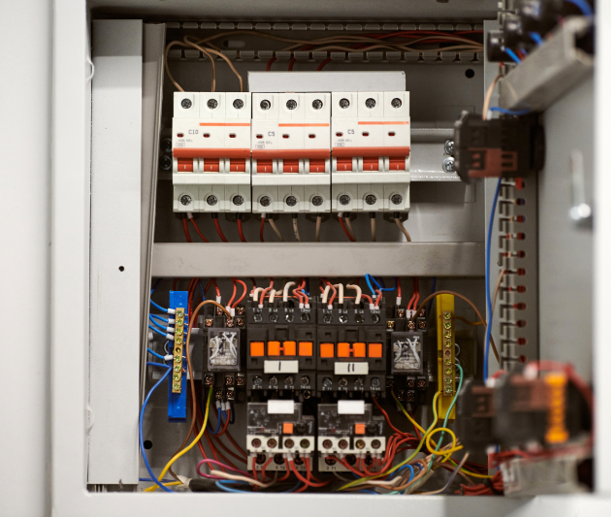
Electrical safety is one of the most critical aspects of any residential, commercial, or industrial installation. At the heart of this protection is the Miniature Circuit Breaker (MCB), a device designed to protect circuits from overcurrents, short circuits, and equipment damage.
But here’s the tricky part: not all MCBs behave the same way under fault conditions. Some trip at the slightest surge, while others withstand higher currents before disconnecting. This behavior is defined by the MCB’s trip curve.
Choosing the right curve is essential. If you select a curve that’s too sensitive, you’ll face nuisance tripping. If you pick one that’s too tolerant, you risk under-protection of the equipment.
This article will break down Types of MCBs: B, C, D Curves and Their Applications—with detailed explanations, real-world examples, and its misconceptions.
Understanding MCBs and Trip Curves
What Is an MCB?
A Miniature Circuit Breaker (MCB) is a protective device designed to automatically interrupt the flow of electricity in a circuit whenever abnormal conditions occur—such as an overload (when the circuit carries more current than it is designed for) or a short circuit (a sudden surge of current due to a direct fault in the wiring or equipment).
In simple terms, an MCB acts like a guard for your electrical system. It continuously monitors the current flow, and the moment it senses danger, it quickly disconnects the supply, preventing damage to wiring, appliances, and reducing the risk of electrical fires.
Key Features of MCBs
- Compact:
- MCBs are designed to be small and space-efficient.
- They are installed in distribution boards (DBs) or consumer units, replacing traditional fuses.
- Their modular design allows multiple MCBs to be mounted side by side, making them ideal for residential, commercial, and industrial setups.
- Resettable:
- Unlike fuses, which melt and need replacement after every fault, MCBs can be easily reset by flipping the switch back to the ON position.
- This saves both time and cost while improving reliability.
- For example, if your kitchen appliance overloads a circuit, you can restore power safely after removing the fault without replacing a fuse wire.
- Safe:
- MCBs provide quick and precise disconnection during abnormal conditions.
- By stopping the current before the wires get too hot, they help prevent electrical fires, damage to equipment, and the risk of electric shocks.
- They also offer clear visual indication (ON/OFF position), so users immediately know the status of the circuit.
Classification of MCBs
MCBs are classified mainly based on two factors:
- Rated Current (In)
- This is the maximum continuous current an MCB can carry without tripping under normal conditions.
- Common ratings include 6A, 10A, 16A, 32A, 63A, etc., depending on the load requirements.
- Example: A 16A MCB is suitable for medium-load applications like power sockets or small appliances.
What Is a Trip Curve?
A trip curve is a performance characteristic of a Miniature Circuit Breaker (MCB) that illustrates how quickly the breaker will disconnect a circuit under different levels of overcurrent. In simple terms, it’s the “personality” of the breaker—defining how sensitive it is to overloads and short circuits.
Think of it as a graph that plots time (how long the breaker takes to trip) against current (how much overload or fault current is flowing). This curve ensures that the breaker can handle small, harmless surges without shutting down the circuit, while still responding instantly to dangerous faults.
Two Key Components of the Trip Curve
- Thermal Tripping (Overload Protection)
- Thermal tripping responds to long-duration overloads.
- Inside the breaker, a bimetallic strip heats up as current exceeds the rated value.
- If a device is drawing, say, 20% more current than its rated load for several minutes, the heat will bend the strip and cause the breaker to trip.
- Example: If a 10A MCB is continuously carrying 12A due to an overloaded extension cord, the breaker won’t trip immediately but will disconnect after a certain time to prevent overheating and fire hazards.
- Magnetic Tripping (Short-Circuit Protection)
- Magnetic tripping responds almost instantly to sudden surges or short circuits.
- It works using an electromagnetic coil that generates a magnetic field proportional to current flow.
- When a very high current passes through (many times the rated value), the magnetic field activates the tripping mechanism within milliseconds.
- Example: A motor startup surge or a short circuit caused by damaged wiring.
Together, these two elements provide dual protection—slow for prolonged small overloads and fast for dangerous short circuits.
Trip Curve Multipliers: B, C, and D Types
The trip curve also tells us how many times the rated current (In) a breaker can tolerate before it trips instantly. This is critical because different loads behave differently when energized.
- B Curve
- Trips at 3–5 times In.
- Very sensitive to surges.
- Best for resistive loads like lighting and heating.
- Example: A 16A B curve breaker trips when current reaches 48A–80A.
- C Curve
- Trips at 5–10 times In.
- Balances sensitivity with tolerance for moderate inrush currents.
- Ideal for inductive loads like fans, refrigerators, and small motors.
- Example: A 16A C curve breaker trips when current reaches 80A–160A.
- D Curve
- Trips at 10–20 times In.
- Designed for heavy-duty equipment with very high inrush currents.
- Common in industrial settings with large motors, compressors, or welding equipment.
- Example: A 16A D curve breaker trips when the current reaches 160A–320A.
What Is a B Curve MCB?
A B Curve MCB is a type of miniature circuit breaker that is designed to trip when the current flowing through it reaches 3 to 5 times the rated current (In). For example, if you have a 10A B curve breaker, it will trip when the current reaches between 30A and 50A. This makes it highly sensitive compared to other curves like C or D, which can withstand much higher multiples of their rated current before tripping.
Because of this sensitivity, B curve MCBs are particularly suitable for circuits where inrush currents are minimal. Inrush current is the short burst of current that occurs when certain devices, like motors or transformers, start up. Since resistive loads (like heaters or lights) don’t produce large inrush surges, B curve breakers can protect them effectively without nuisance tripping.
Another key feature of B curve MCBs is that they provide fast disconnection times. Depending on the level of overload, they typically trip within 0.04 to 13 seconds. This rapid response ensures that faults are cleared before they can damage appliances, wiring, or cause fire hazards.
Where Are B Curve MCBs Used?
B curve breakers are almost exclusively found in domestic and light commercial installations, where loads are simple and predictable. Some common applications include:
- Residential lighting circuits:
- Ideal for protecting lamps, LED drivers, and other lighting systems that don’t generate inrush currents.
- Prevents overheating of cables and fixtures, especially in modern LED systems that are more sensitive to surges.
- Heating systems:
- Used in circuits for water heaters, geysers, toasters, and ovens.
- Since these are purely resistive loads, they operate without sudden current spikes, making B curve MCBs the safest option.
- Sockets for small appliances:
- Suitable for laptops, televisions, personal computers, and other electronics.
- These devices require sensitive protection to prevent damage from small overcurrents or wiring faults.
Why B Curve?
There are three main reasons why B curve MCBs are the standard choice for household electrical circuits:
- Perfect for Resistive Loads
- Appliances like lights and heaters operate on steady currents without sudden fluctuations.
- B curve MCBs, with their low trip threshold, provide just the right balance between sensitivity and safety.
- Maximum Sensitivity for Fire Safety
- Their quick response ensures that even small overcurrents or wiring faults are detected immediately.
- This reduces the risk of electrical fires, which are often caused by prolonged overheating of cables.
- Compliance with International Standards
- B curve MCBs conform to IEC 60898 and IS/IEC 60898 standards, which govern low-voltage circuit protection for domestic installations.
- This guarantees they meet the safety and performance requirements expected in homes and light commercial spaces worldwide.
What Is a C Curve MCB?
A C Curve Miniature Circuit Breaker (MCB) is a type of circuit protection device designed to trip when the current exceeds 5 to 10 times its rated current (In). This makes it less sensitive than a B curve breaker but more sensitive than a D curve breaker, striking a balance that works well for circuits with moderate inrush currents.
Inrush current refers to the short, high surge of current drawn when certain equipment starts up, such as motors, air conditioners, or transformers. Unlike purely resistive loads (like lamps or heaters), these inductive loads temporarily draw several times their rated current at the moment of switching on. A B curve MCB might interpret this inrush as a fault and trip unnecessarily, whereas a C curve MCB tolerates this surge without nuisance tripping.
Despite this tolerance, a C curve breaker will still react almost instantly to genuine faults such as short circuits or severe overloads. In such conditions, it trips within milliseconds, disconnecting the circuit to prevent damage to equipment, wiring, or users.
Where Are C Curve MCBs Used?
Because of their balance between sensitivity and tolerance, C curve MCBs are the most widely used type in commercial and mixed-use environments. Some common applications include:
- Commercial Buildings
- Used in office wiring, retail shops, and small workshops.
- Ideal for environments where circuits power a mix of devices like lighting, computers, printers, and small appliances.
- Prevents nuisance tripping while ensuring effective protection against overloads and faults.
- HVAC Systems
- Applied in air conditioners, fans, exhaust systems, and ventilation units.
- These systems typically have moderate startup surges when compressors or motors kick in.
- A C curve breaker ensures that normal inrush doesn’t cause false trips but still disconnects quickly during abnormal faults.
- Small Motors and Transformers
- Suited for equipment that draws 5–8 times its rated current during startup.
- Examples: water pumps, refrigeration units, and small transformers used in commercial power distribution.
- Protects equipment while allowing it to start normally without interruption.
- Mixed-Load Environments
- In facilities where both resistive loads (lights, heaters) and inductive loads (motors, fans) are present, C curve MCBs offer the best compromise.
- Common in schools, hospitals, restaurants, and small manufacturing units, where varied electrical loads operate on the same distribution system.
Why Choose a C Curve MCB?
C curve MCBs are often considered the most versatile and practical option for many installations. Here’s why:
- Versatility
- Can handle both resistive and inductive loads, making them suitable for a wide range of environments.
- Ideal for locations with mixed-use electrical systems.
- Balanced Sensitivity
- More tolerant than B curve breakers, so they don’t trip unnecessarily during equipment startup.
- More sensitive than D curve breakers, so they still provide fast disconnection for commercial and light industrial systems where fault levels aren’t extremely high.
- Effective Protection
- Offers quick disconnection under heavy faults, safeguarding equipment, wiring, and people.
- Helps maintain operational continuity by reducing nuisance tripping, which can cause downtime in businesses.
- Most Common Choice for Commercial and Light Industrial Installations
- The majority of modern offices, retail spaces, and small factories rely on C curve MCBs as their go-to protection.
- They provide the right balance of performance, safety, and cost-effectiveness.
What Is a D Curve MCB?
A D Curve MCB is a type of Miniature Circuit Breaker (MCB) designed to trip when the current flowing through it exceeds 10 to 20 times the rated current (In). This curve is specifically tailored for circuits that experience high inrush currents—such as large motors and industrial equipment. The higher tolerance for inrush currents means that D curve breakers can handle the short, high current surges that occur when heavy equipment starts up.
Key Features of D Curve MCBs:
- Trips at 10 to 20 times the rated current: This trip range makes D curve MCBs less sensitive than B or C curves but well-suited for handling heavy-duty loads.
- Built for high inrush currents: This is the primary reason for choosing a D curve MCB—its ability to tolerate large initial current surges (inrush) that would cause B or C curve MCBs to trip unnecessarily.
- Less sensitive than B or C curves: While B and C curve MCBs are designed to respond to smaller overcurrents and moderate surges, D curve MCBs are specifically designed to endure the high currents that are typical when starting large motors and other industrial equipment.
- Highly effective for heavy-duty loads: Despite its lower sensitivity, the D curve MCB offers high reliability in circuits that require resilience to frequent high currents, without sacrificing safety.
Where Are D Curve MCBs Used?
D curve MCBs are typically used in environments where heavy-duty equipment is involved and where high inrush currents are normal during equipment startup. Some of the most common applications include:
1. Industrial Machinery
- Large motors, compressors, conveyor belts, and manufacturing machinery.
- These machines often experience high inrush currents (up to 10–12 times the rated current) when first powered on, especially in heavy industries like mining, manufacturing, and chemical processing.
- Example: A large industrial motor starting up can draw significantly more current than its normal operating load. A D curve MCB will tolerate this initial surge without tripping, protecting the motor and the circuit.
2. Heavy-Duty Pumps
- Pumps used in industrial settings—for example, in water treatment plants, HVAC systems, or in large-scale chemical or oil processing.
- These pumps often have starting currents that range from 8–12 times their nominal rating, meaning they would trip B or C curve MCBs unnecessarily.
- Example: A large water pump in a municipal water treatment plant can draw massive startup currents. A D curve MCB ensures the circuit is protected while preventing frequent tripping during operation.
3. Specialized Equipment
- Welding machines, X-ray units, medical imaging devices, and other equipment with significant inrush current.
- These devices may need a substantial amount of power to start up, often resulting in short but intense surges of current that D curve MCBs are designed to handle without disrupting operations.
- Example: Welding machines used in construction or automotive repair often have high inrush currents when first energized. A D curve MCB prevents frequent trips during normal equipment use, ensuring the protection of both the equipment and electrical wiring.
4. Workshops with High Startup or Fluctuating Electrical Loads
- In workshops, factories, or heavy-duty equipment areas, where multiple machines are started and stopped regularly, D curve MCBs are necessary to manage high startup currents and avoid overtripping.
- Example: A metalworking shop with multiple lathes, drills, and heavy motors can experience frequent inrush current surges when starting different machines. A D curve MCB will protect the circuits and minimize downtime caused by tripping.
Why Choose a D Curve MCB?
D curve MCBs are essential for circuits that regularly experience high inrush currents, which are typical in many industrial and heavy-duty applications. Here’s why you should choose a D curve MCB:
1. Prevents Nuisance Tripping During Startup of Heavy Motors
- Heavy motors and equipment, such as those used in industrial environments, often draw inrush currents that can be 10 to 20 times their rated current.
- B and C curve MCBs would trip immediately in such cases, leading to nuisance tripping—interrupting operations unnecessarily.
- The D curve MCB is designed to tolerate high inrush currents, ensuring that equipment like motors and pumps can start without causing frequent circuit interruptions.
2. Necessary in Industrial Plants Where High Inrush is Normal
- In industrial plants, large equipment and machinery are often in continuous operation, requiring substantial power to start up.
- A D curve MCB ensures continuous protection without disrupting operations, making it ideal for sectors like manufacturing, construction, mining, and oil & gas.
- Without the tolerance of a D curve, these plants would experience significant operational downtime due to unnecessary trips.
3. Ensures Safety Without Disrupting Operations
- The D curve MCB ensures safe disconnection during fault conditions (such as a short circuit or sustained overload), while minimizing disruptions to normal operations.
- This is critical in environments where minimizing downtime is a key business priority, and where constant operation of heavy machinery is required.
- The D curve also helps in compliance with industry safety standards, protecting both equipment and personnel from potential electrical hazards.
Common Misconceptions About MCB Curves
Misconception 1: “Higher curve is always better.”
- Reality: Higher curves like D-type are less sensitive. Using them in homes or small offices can delay fault clearance and create fire hazards. Always match the curve to the load type, not just “go higher” to avoid trips.
Misconception 2: “Any MCB can be used for any load.”
- Reality: Each curve is designed for a specific load profile. For example, a B curve breaker in a motor circuit will cause nuisance tripping, while a D curve in a residential circuit may fail to trip in time.
Misconception 3: “B curves are outdated.”
- Reality: Far from it. B curve MCBs are still the best choice for resistive loads like household lighting and heating. They remain essential in modern domestic wiring.
Misconception 4: “MCB curves only affect tripping speed.”
- Reality: Curves also define the fault tolerance of the circuit. Choosing the wrong curve can impact coordination with other devices, cable protection, and even arc energy levels. It’s not just about speed—it’s about complete system safety.
Misconception 5: “C curve breakers are universal and can replace B or D anywhere.”
- Reality: While C curve MCBs are versatile, they are not a one-size-fits-all solution. In purely resistive residential circuits, they may trip too late, while in heavy industrial loads, they may still nuisance trip. Correct selection is always application-based.
Misconception 6: “Trip curves don’t matter if the breaker’s rated current (In) is correct.”
- Reality: Rated current ensures the breaker matches the load size, but the trip curve ensures it responds appropriately to surges and faults. Even with the correct In rating, the wrong curve can lead to poor protection or operational issues.
Misconception 7: “D curve breakers are only for motors.”
- Reality: While motors are the most common application, D curve MCBs are also used for transformers, welding equipment, X-ray machines, and other high inrush devices. Limiting them only to motors ignores their broader industrial utility.
Conclusion: Choosing the Right MCB Curve for Your Application
When it comes to protecting electrical circuits, Miniature Circuit Breakers (MCBs) are indispensable. They ensure that your circuits remain safe from overloads and short circuits, preventing damage to wiring, appliances, and reducing the risk of fire hazards. However, selecting the right MCB curve is just as important as choosing the right breaker rating.
The B, C, and D curves each offer distinct advantages tailored to different applications, making it essential to understand the specific requirements of your system before making a choice:
- B Curve MCBs are perfect for residential circuits with low inrush loads like lighting and heating, offering high sensitivity and fast disconnection for maximum safety in household settings.
- C Curve MCBs are the most versatile, providing a balance between sensitivity and tolerance, making them ideal for commercial environments like offices, small workshops, and HVAC systems with moderate startup surges.
- D Curve MCBs are designed to handle high inrush currents found in industrial applications such as large motors, pumps, and specialized equipment. They offer reliable protection without causing nuisance trips during motor startups or heavy load fluctuations.
By selecting the correct MCB curve for your application, you ensure optimal performance while safeguarding your equipment, reducing unnecessary downtime, and enhancing operational safety. Remember, the right choice of MCB not only protects your electrical system but also contributes to long-term cost savings by preventing damage to valuable equipment.
Frequently Asked Questions (FAQs)
1. What is the difference between B, C, and D curve MCBs?
- B trips at 3–5 × In (residential).
- C trips at 5–10 × In (commercial).
- D trips at 10–20 × In (industrial).
2. Can I use a D curve breaker in my house?
No. Fault currents in homes are too low for D curves to react quickly, creating safety risks.
3. Why is the C curve the most common?
It balances sensitivity and tolerance, making it ideal for mixed commercial loads.
4. How do I know which curve to use?
Base it on load type, installation environment, and fault level.
5. Are there other curves beyond B, C, and D?
Yes—like K curve (for transformers) and Z curve (for sensitive electronics)—but they are less commonly used in general installations.