Stakes of the Application Essay
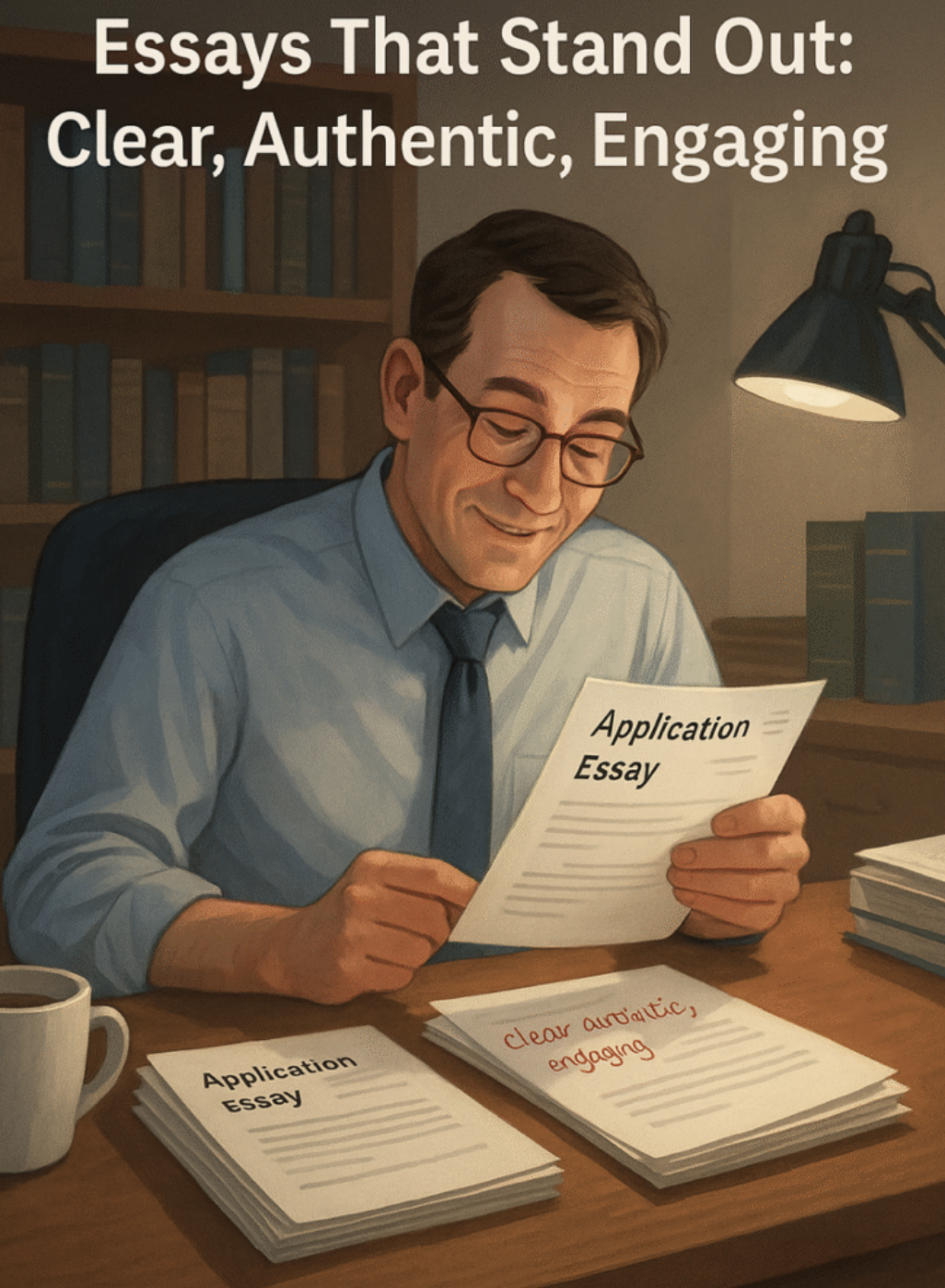
Imagine you’re an admissions officer. You’re at your desk and it’s the end of the day. You’ve read forty essays and you have another stack still left. They all sound very similar, half have the word passion and the other half are about resilience. Then there is an essay that feels different. It isn’t the longest or most complex, it doesn’t have the fanciest vocabulary. The storytelling feels natural and authentic. In a few paragraphs, you feel moved by a student you’ve never met.
For applicants, this is the challenge and the opportunity. Even a powerful story can fall flat if the writing feels clunky, repetitive, or overly formal. Clarity is often the difference between an essay that grabs an admissions officer and one that blends in with the rest.
Sitting down to write a first draft is only half the battle. What matters is how you refine it so that the language feels seamless and the voice feels authentic. Tools like GPTHumanizer can support that process by enhancing readability and polishing phrasing. And, critically, without scrubbing out the messy individuality that makes your story yours.
What Admissions Readers Are Really Thinking
Admissions officers aren’t reading application essays with a red pen in hand. They’re not looking for the occasional spelling error or misplaced comma. Their first question is: was this essay written by a sentient human?
They scan most essays in just a few minutes. In that time, they’re looking for three things:
- Clarity – Can they understand the point the writer is trying to make?
- Flow – Do the ideas connect to one another, or do they bounce all over the place?
- Authenticity – Does this essay sound like it came from a real person, or is it a generic template?
A distinct voice and genuine hook draws them in. Short, clear sentences keep them reading. A natural flow and phrasing makes them remember the student in committee. But essays packed with cliché́s, rigid or overly formal phrasing start to blend together.
Take the following as an example:
- Artificial: “Since my early childhood years, I have consistently demonstrated resilience which has influenced my journey in life.”
- Clear: “Since childhood, resilience has shaped my journey.”
It’s almost the exact same idea. But one version buries the idea. The other brings it to the front and makes it memorable.
We have a ton of great examples of students who went from wordy and cliché first drafts to stronger second drafts. You can check them out on visit website
Pitfalls in the Application Essay
Even the most well-intentioned students can fall into application essay traps. The culprit is usually not the story itself, but how the story is portrayed on the page.
1. Overly Formal Tone and Distancing Language
Many application essays enter the Dumbo octopus zone. Instead of showing rather than telling, they read like academic papers removed from the person who wrote them.
- Awkward and robotic: “My extracurricular activities demonstrate leadership qualities and a commitment to service.”
- Better: “Through my extracurricular activities, I discovered how much I enjoy leading and serving others.”
2. Wordiness and Repetition
Too often, application essays get buried in a thicket of prepositional phrases. What takes two sentences in plain English requires seven in essay-ese.
- Wordy: “In my journey of personal development, I have encountered a variety of challenges, each of which contributed to shaping my identity.”
- Clear: “The challenges I faced shaped my identity.”
3. Editing Out the Personal Voice
Some essays lose their humanity in the endless editing process. They are grammatically perfect, cliché free, and lack anything that makes them memorable. With a buzzer in hand, an admissions officer would have no way of differentiating between writers.
The good news? Every single one of these is a fixable problem.
Ways to Humanize the Essay with Humanize AI
 Some students dabble with the idea of using another AI technology to draft or polish their essays. But what happens when the essay starts to sound unnaturally similar to every other essay out there? Admissions officers can sniff that out. The application essay doesn’t need to be perfect, it needs to have personality.
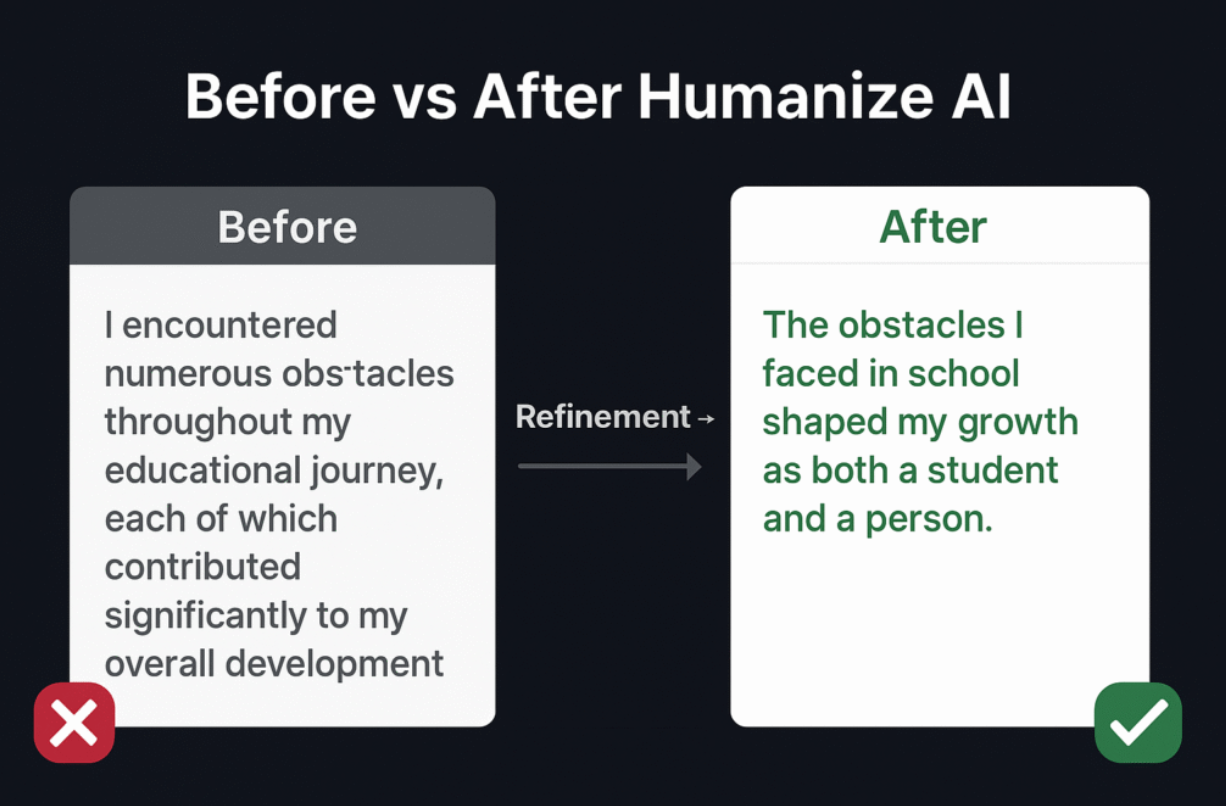
What does it mean to humanize your writing? The goal isn’t to rewrite every word. It’s to smooth the rhythm, and refine the phrasing. For example:
- Robotic: “I encountered numerous obstacles throughout my educational journey, each of which contributed significantly to my overall development as a student and individual.”
- Humanized: “The obstacles I faced in school shaped my growth as both a student and a person.”
In the second set of examples, the sentence reads how a person would speak it. Humanize AI can support that refinement process, helping writers improve clarity and flow while still maintaining their authentic voice.
Beyond Grammar: Rhythm and Storytelling
Humanizing isn’t just about grammar or spelling, there are spellcheckers for that. It’s about rhythm and storytelling. When we’re reading, our eyes naturally glide over writing that varies in rhythm: short sentences that pack a punch and longer ones that build on an idea. Too many sentences that are alike start to feel unnatural, like the writing is hiding something, and the person doesn’t want to share their story.
A strong application essay varies the flow and lets the story’s personality drive the writing. A vivid hook might share a quick, hyped-up anecdote, with short sentences. More reflective portions might use longer sentences and more detail to take the reader deeper into your past. This conversational and lived-in rhythm naturally flows between points and keeps the admissions officer engaged from start to finish.
A Reader’s Journey: Refining, One Step at a Time
Here’s how Maya, a high school senior, refines her personal statement:
- Brain dump: Maya brain dumps 900 words. She has stories to share, volunteering with her family, being a caretaker, her aspirations to study medicine. The essay is full of ideas, but it’s a lot to read.
- Refining by section: Maya refines her essay by going through and editing one paragraph at a time. She cuts out long sentences and wordier transitions that add bulk but not clarity.
Before: “During my high school years, there were many different situations and challenges that influenced my personal development and made me stronger in a variety of ways.”
After: “In high school, challenges made me stronger.”
- Reading aloud: Maya reads the essay aloud. Yep, it still sounds like her. She didn’t send every sentence through Humanize AI, only the ones where the story felt buried or awkwardly phrased. The same plot points are there, just phrased in a way that is easy to read and digest. It’s still Maya’s story, but a reader can finish the essay without getting lost in wordiness.
The end result? Maya’s essay is shorter. Her second draft has 650 words instead of 900. Refinement didn’t cut her voice, but made her message stronger and clearer.
Why Clarity Matters: Beyond College Applications
It’s tempting to see the personal statement as the final boss, one you defeat and never have to worry about again. But the ability to communicate clearly is one that students use again and again throughout their careers. While it’s a different medium and audience, students use these same skills to write scholarship application essays, internship cover letters, and even research proposals. Professors love it. Supervisors love it. Why? Writing with that level of clarity communicates confidence, a student who knows who they are and what they bring to the table.
Clarity in Collaboration
Clarity isn’t just important for a student’s own work, it helps students collaborate with others. In a lab, internship, or student group, nothing sinks a good idea like a rambling email or a slide full of jargon. Writing with clarity and purpose helps students build trust with their teams. Over time, students who practice how to refine their writing often find that their writing is more than just a tool, it’s part of their reputation. Strong communication is a competitive advantage, one that pays dividends long after a student leaves campus.
Conclusion: Clear Essays, Authentic Stories
At the end of the day, admissions officers don’t care about five-syllable vocabulary words or perfect grammar. They care about clarity and authenticity, a sense of a real person behind the page.
Your story matters. What determines its impact is how you tell it. By drafting honestly, refining in sections, and reviewing for authenticity, you can turn a rough draft into an essay that is easy to read and impossible to forget.
Tools like GPTHumanizer can help you polish phrasing and enhance readability, all while staying true to your unique perspective. The result isn’t an essay that sounds robotic, it’s one that sounds like you.
Clarity ensures your essay gets read. Authenticity ensures your essay gets remembered.