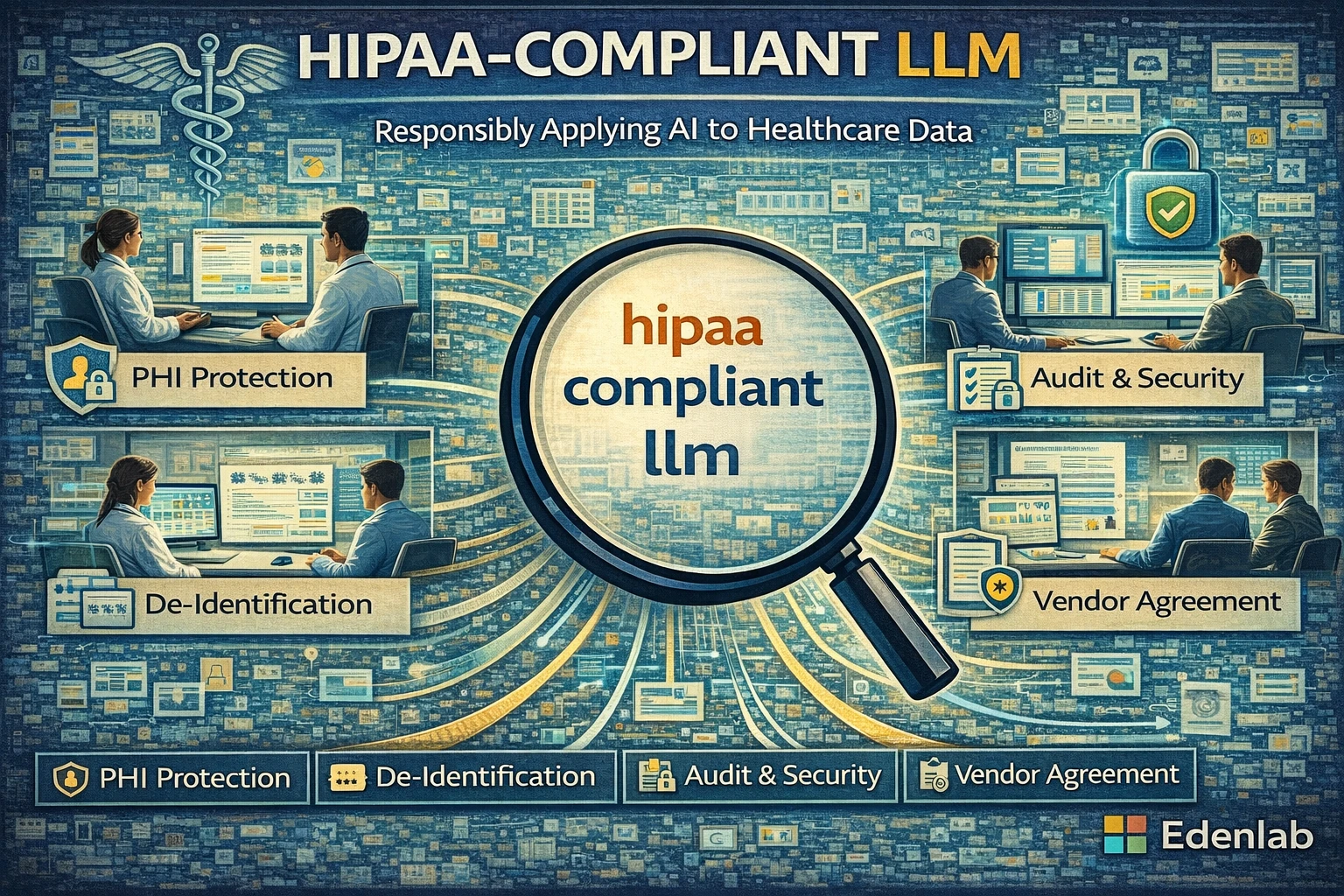
Healthcare teams want the speed of AI without compromising patient privacy. That tension becomes especially obvious with large language models: they can summarize notes, draft letters, answer internal questions, and accelerate analytics work—but they can also create new risk if protected health information (PHI) is handled carelessly. Building an AI workflow that fits healthcare expectations is less about “turning on a model” and more about designing controls around data access, storage, auditing, and vendor responsibility. A hipaa compliant llm approach is best understood as a complete system design—policies, architecture, and security practices working together—rather than a single product label.
What “HIPAA compliant” means in practice
HIPAA isn’t a badge you paste on software. It’s a set of rules that covered entities and business associates must follow to protect PHI. When LLMs are involved, the same fundamentals apply: ensure confidentiality, limit use and disclosure, and protect against unauthorized access. In practical terms, HIPAA compliance requires you to answer questions like: Who can access PHI? Where does PHI flow? Is it stored? For how long? Is it logged? Can a user accidentally expose sensitive data through prompts or outputs? Can a third-party provider access or reuse that data?
The three layers you must align: policy, contract, and technology
HIPAA readiness for LLM use generally comes down to three aligned layers. First, policy: clear internal rules for what staff can send to an AI system, which use cases are allowed, and which data types are restricted. Second, contract: if an external vendor is involved and PHI is processed, you typically need a Business Associate Agreement (BAA) that defines responsibilities and safeguards. Third, technology: controls that enforce privacy and security—access control, encryption, auditing, and data minimization—so the system behaves safely even when users make mistakes.
PHI risk in LLM workflows: where it usually happens
Most risk comes from data leaving the controlled environment or being retained in ways you didn’t intend. Common risk points include users pasting PHI into consumer-grade chat tools, prompts and outputs being stored in logs without proper protection, third-party tooling collecting telemetry that contains sensitive text, or model providers using submitted content to improve services. Another risk is accidental over-disclosure: a model can include more PHI than necessary in an output, or combine details in a way that reveals identity when it wasn’t required.
The “minimum necessary” mindset for AI prompts
One of the safest habits in healthcare is reducing PHI exposure wherever possible. The minimum necessary principle means you should not send more identifiable data than the task requires. For many AI tasks, you don’t need names, full dates of birth, addresses, or phone numbers. You often can work with a patient ID, age range, or de-identified snippets. This mindset dramatically reduces risk and makes downstream compliance easier: less PHI in prompts means less PHI to protect in storage, logs, and outputs.
De-identification, redaction, and structured inputs
A practical way to reduce exposure is to build redaction or de-identification into the pipeline before text reaches the model. This can be done with pattern detection (dates, names, MRNs), clinical entity recognition, or rule-based filters. Another pattern is to avoid sending raw notes when you can send structured fields instead: problems list, meds, key lab trends, or coded observations. When the model receives clean, structured context, it can still produce helpful outputs while minimizing the chance of leaking sensitive details.
Vendor and deployment choices: what to verify
Whether you use a cloud API, a private deployment, or an on-prem setup, you need clarity on a few non-negotiables. If PHI is involved, confirm whether the vendor will sign a BAA. Verify data handling terms: whether prompts and outputs are stored, how long they are retained, who can access them, and whether they are used for training. Confirm encryption in transit and at rest. Ask about tenant isolation (your data separated from others). Validate incident response commitments and audit capabilities. These checks help ensure your LLM usage fits the operational reality of HIPAA rather than relying on assumptions.
Security controls that make or break compliance
HIPAA-aligned LLM systems usually require a baseline set of controls. Role-based access control ensures only authorized users can query PHI. Strong authentication (often with SSO and MFA) reduces account compromise risk. Encryption protects PHI during transmission and storage. Audit logs record who accessed what and when, which is essential for investigations and compliance reviews. Data loss prevention (DLP) can stop users from pasting sensitive content into unsafe fields or sending outputs to unauthorized channels. Finally, retention rules should limit how long prompts and outputs are kept and ensure secure deletion when no longer needed.
Output safety: controlling what the model is allowed to reveal
Even if inputs are handled correctly, outputs can create risk. A good system constrains outputs so they match the purpose. For example, if the task is to generate a discharge summary template, the output should avoid adding unnecessary identifiers. If the task is to draft a payer letter, the output should only include the relevant clinical facts and the minimum identifying details required. Some organizations use post-processing checks that scan model outputs for PHI and block or warn before the text is saved or shared.
Prompt injection and “retrieval” risks in healthcare settings
When LLMs use retrieval-augmented generation (RAG) to pull context from documents, you must treat that context store like a sensitive clinical system. Access controls must apply to retrieval as well as generation, otherwise users might retrieve notes they are not authorized to view. Prompt injection is another risk: a malicious or accidental instruction inside a document could cause the model to reveal information outside the user’s scope. Mitigations include strict retrieval permissions, content filtering, and system-level instructions that prevent the model from exposing data beyond the user’s entitlements.
Building a HIPAA-aligned architecture for LLM use
A robust pattern is to keep PHI inside a controlled environment and send only what is needed to the model, with clear boundaries around storage and logging. Many teams separate components: a secure data layer (EHR/warehouse), a protected retrieval layer (permissioned indexes), and an AI layer (model inference) with strict monitoring. The system records events for auditing but avoids storing full PHI in logs unless absolutely required. This architecture approach helps turn “LLM usage” into a governed service rather than an uncontrolled chat experience.
A note on Edenlab
Edenlab works with healthcare and healthtech engineering, which is especially relevant when you need AI features that fit regulated environments. The difference between a demo and a production-grade healthcare solution is typically the surrounding system: secure integration, access control, auditability, and careful handling of sensitive data. A team experienced in healthcare constraints can help design workflows where AI delivers real utility while still respecting privacy and operational requirements.
Making “hipaa compliant llm” a real capability, not a claim
The most reliable way to think about hipaa compliant llm is as a set of enforceable decisions: limit PHI exposure, formalize vendor responsibilities, secure the full data path, and ensure every interaction is auditable. When those pieces are in place, LLMs can safely support high-value healthcare tasks like documentation assistance, patient communication drafts, care coordination summaries, operational analytics explanations, and internal knowledge support—without treating privacy as an afterthought.