30% of the world’s total data is generated by the healthcare systems.
And this has brought new problems with it. You see, let’s just say, 10 or 15 years prior to this, only a small amount of data was available in the industry. Meaning, if you had to run or manage a practice effectively, the data load that was present then was negligible.
However, today, US clinicians face burnout, data overload, and growing administrative pressure. Managing 30% of the total data and finding meaningful insights from it for care delivery, and getting administration data, is a tough task. Furthermore, the worst part is that the data is still increasing, and it will only increase more by each passing day.
Due to this, many healthcare practices are actively making their shift to smart systems with custom EHR software development. You see, most of the traditional off-the-shelf EHR systems are meant for record-keeping, but today, the need has shifted to efficiency and access to insightful data.
And let’s be honest, generic systems are simply unable to adapt to the real clinical workflows, resulting in increased care burden and productivity loss.
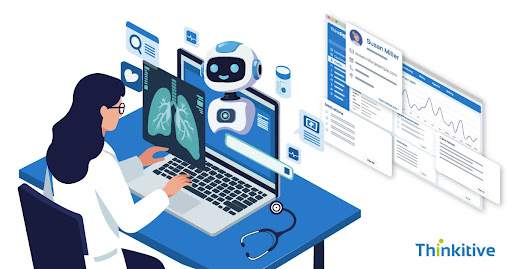
However, a possible solution you must explore while developing custom EHR software is that of AI in EHR systems. With AI, automated EHR workflows can be initiated, and other AI-powered features can further lead to an increase in productivity, improvement in care delivery, and reduced care burden.
On that note, in this blog, the role of AI & automation in the modern custom EHR system is discussed, and how it can improve the core aspects of care delivery and documentation.
The Real Limitations of Traditional EHR Systems
Before building a custom EHR software, let’s first know the limitations of a traditional EHR system and how it has become a problem for modern-day healthcare practices.
The very first problem that providers face with traditional EHR systems is manual workflows and manual data entry practices. Now, as per some studies, providers spend around 36% of their time on documentation. This drastically reduces the patient-facing time, which the patient rightfully deserves for a holistic care journey.
Other than that, every generic or traditional EHR system is developed with a one-size-fits-all approach. Now, this works wonderfully for a generic practice, but when it comes to a specialty, it simply is not able to match its needs. From workflows to documentation requirements, everything seems to be a miss. This inability not only disrupts the workflows, but capturing of accurate information is not made possible.
On top of that, with very limited room for customization and flexibility, the chances of the creation of data silos are huge. Due to this, even your AI in EHR systems won’t be able to turn the clinical data into actionable insights.
And these are just a few of the many limitations that you get with a traditional EHR system.
How AI & Automation Transform Custom EHR Software
You must have AI and automation to transform your EHR system by turning your normal EHR software into healthcare automation software with automated EHR workflows. To help you understand this better, here are certain features that AI in the EHR system brings that can transform your software:
- Smarter Documentation: One of the best ways to remove the excessive burden of documentation is through AI in EHR systems. For instance, with voice-enabled and AI-assisted charting practices, the typing efforts of healthcare providers can be eliminated, and after-hours work can be skipped. This would work great if your intelligent EHR solution is able to pick the essential pointers during consultation.
- Workflow Automation: Some of the repetitive tasks that make up a major aspect of your clinical and documentation workflow, like scheduling, appointment reminders, intake process, and task routing through your EHR system, can be enhanced. You see, with EHR, all you have to do is fill in the information once at the entry levels and only add on essential information as it moves forward. This removes the chances of errors and brings symmetry to processes.
- Clinical Decision Support: The most demanded feature in custom EHR software development is that of clinical decision support. With this feature, you can create context-aware alerts for medications, care gaps, and risks. This way, any things that you might miss during consultation or follow-ups can be easily covered to provide better and more effective care.
- Improved Interoperability: If you are able to achieve interoperability with FHIR HL7 standards, then you give your systems the ability to exchange data and communicate with disparate systems in a better way. With intelligent data mapping between labs, pharmacies, and external systems, your system will be able to pull or push certain data to make the care delivery process much smoother and better.
Why Custom EHR Software Development Makes the Difference
Though we have just scratched the surface of intelligent EHR solutions with AI in EHR systems, it still holds the potential to make a difference in a lot of aspects of a practice.
For instance, the core requirement of AI is flexibility. And this works best when it is implemented in real clinical workflows and not forced into rigid systems. This way, you can not only curate workflows that are specific to your practice with a defined flow of data from different components of your software.
So, with AI in EHR software, you not only simplify your workflows but also define the way data flows across systems to give you the desired results.
However, during this one thing, you must keep in mind that automation is its specific application. Only when it is applied in a correct way and for correct data fields can it save time for your providers and practice.
On top of that, the flexibility and customization liberty it gives allows you to meet the ever-changing needs of your healthcare regulatory landscape very effectively.
Practical Benefits for Providers & Practices
Some of the practical or real-world benefits for providers and practices that you can get with AI in an EHR system that allows automation are:
- Reduced Documentation Burden: With automation being one of the major benefits of AI in EHR software, it can literally reduce the documentation burden by a huge margin. Moreover, the burnout chances of the clinicians are also reduced, with some studies showing a reduction in pajama time with AI.
- Faster & Consistent Workflows: With a custom EHR system, you define systems with specific workflows and dataflows, right from the start to the very end. This allows your staff members to work efficiently without much hassle and handle day-to-day tasks at a much faster pace.
- Improved Care Coordination: Your automated EHR workflows work only when your systems are connected. Due to this, it ensures that all the members in your care team are on the same page and working towards the same goal. With this improved coordination in care delivery, you can effectively enhance care and give a delightful experience to patients during their care journeys.
- Cleaner Data: Your intelligent EHR solutions run on clean data. This supports some of the core administrative aspects of your EHR systems, like billing, reporting, and decision making. With clean data, you can not only make your billing aspects better, but also prepare better reports and make better decisions.
Conclusion: From Passive Records to Intelligent Support
Automation powered by AI in EHR systems is redefining what EHR should do and what they can do. However, a lot of things in this depend specifically on implementation and the continuous progress that is made in the system after that. Due to this interactive exchange of dialogues, it can be implemented better and made into a final piece.
Furthermore, with a strategic custom EHR software development approach, healthcare practices can move beyond data entry and towards intelligent and efficient care delivery. So, what are you waiting for? Click here to get your first free consultation.
FAQs
- How does AI improve custom EHR software?
AI enhances custom EHR software by turning raw clinical data into actionable intelligence. Instead of acting as a passive data repository, AI-enabled EHRs can:
- Surface relevant patient insights at the point of care
- Support clinical decision-making using predictive analytics and pattern recognition
- Identify care gaps, risks, and trends across patient populations
In custom EHR software development, AI is embedded around real workflows—not bolted on—making the system smarter with use, while remaining clinically aligned.
- Can automation reduce clinician documentation burden?
Yes, automation is one of the most impactful benefits of modern EHR design. Automated EHR workflows can:
- Pre-fill documentation using structured data and clinical context
- Automate routine tasks like order routing, follow-ups, and reminders
- Reduce repetitive clicks and manual data entry
The result is less administrative work, faster charting, and more time for clinicians to focus on patient care—directly addressing burnout and efficiency challenges.
- Is AI-powered EHR software safe and HIPAA-compliant?
AI-powered EHR systems can be fully secure and HIPAA-compliant when designed correctly. In custom healthcare automation software:
- AI models operate within secure, access-controlled environments
- Data encryption, audit trails, and role-based access remain foundational
- AI supports workflows without compromising patient data integrity
Importantly, compliance is handled at the architecture level, ensuring AI enhances safety rather than introducing risk.
- Does AI replace clinicians in EHR workflows?
No. AI does not replace clinicians—it augments them. Intelligent EHR solutions are designed to:
- Assist with recommendations, not make autonomous clinical decisions
- Reduce cognitive load, not clinical responsibility
- Support consistency while preserving clinical judgment
In modern custom EHR systems, AI acts as a clinical co-pilot, helping clinicians work smarter without removing human oversight or accountability.
- Why AI & automation matter in custom EHR software development
AI and automation are no longer “advanced features”—they are becoming foundational capabilities of scalable, future-ready EHR platforms. When implemented through custom EHR software development, they align technology with real-world clinical workflows, regulatory needs, and operational goals.
Winston Human Score:
Semrush SEO Score: